
The Science Behind Colorful Sunrises and Sunsets
During sunrise and sunset, we can see the sky change through a wide range of colors. At one moment, it may appear red or orange, and as time passes, it may turn pink. On other days, the sky may look purple or golden. These color changes occur for several scientific reasons.
When the Sun is close to the horizon, sunlight travels through a much longer path of Earth’s atmosphere. As it interacts with air molecules, dust, moisture, and clouds, different wavelengths of light are scattered or filtered in different ways, creating the variety of colors we see in the sky.
Now, let’s take a closer look at how each of these colors is created.
Why the sky is blue during the day
Before discussing the red, orange, gold, and other colors created by sunlight, let us begin with the color blue. We all know that the sky appears blue when the Sun is high above the horizon. This means that the color of the sky is affected by sunlight, but why does the sky look blue when the Sun is high in the sky?
The reason is fairly simple. Sunlight is made up of many colors with different wavelengths, including red, orange, yellow, green, blue, and violet. When the Sun is high above the horizon, sunlight travels through a relatively short distance of the atmosphere. Most of the longer-wavelength red and orange light passes through the atmosphere more directly, while shorter-wavelength blue light is scattered in many directions by air molecules. As a result, blue light reaches our eyes from across the sky, making the sky appear blue.
Why sunrise and sunset look red or orange
Why, then, do the colors of the sky change at sunrise and sunset? At these times, the Sun is close to the horizon, meaning that it is low in the sky. As a result, sunlight must travel through a much longer stretch of the atmosphere before reaching our eyes.
Along this longer path, much of the shorter-wavelength blue and violet light is scattered away from the direct line of sight. The sunlight that reaches our eyes therefore contains a greater proportion of longer wavelengths, including yellow, orange, and red. This is why the sky can appear red, yellow, or orange rather than blue around sunrise and sunset.
On some days, the sky appears especially red or displays unusually deep colors. This can happen when the air contains dust, smoke, or tiny water droplets. These particles change the way light is scattered through the atmosphere and can sometimes make red and orange tones appear deeper and more vivid.
How clouds create pink and purple skies
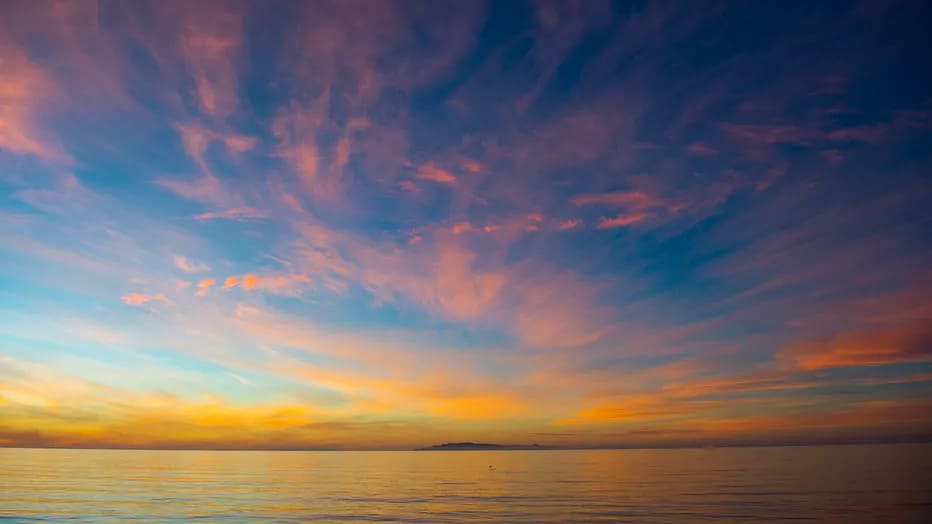
Finally, let’s look at why the sky sometimes appears unusually pink or purple. We have already discussed why the sky can appear blue, orange, or red. Under certain conditions, these warm and cool colors can appear together, creating shades of pink, lavender, or purple.
The colors of the sky can look different every day depending on atmospheric conditions, moisture, dust, and cloud cover. However, low and thick clouds may block the sunlight entirely, preventing these colors from appearing. That is why taking a moment to look at the sky around sunrise or sunset can offer a different and interesting view each day.
Why some sunsets are more colorful than others
As mentioned earlier, the colors of the sky can sometimes appear deeper, more vivid, or spread across a wider area. Several factors can influence this, but dust, moisture, and other particles in the atmosphere often play an important role.
When the air is clear and contains relatively little dust, sunlight can produce bright golden and orange tones. When haze or fine particles are present in the atmosphere, red colors may become more intense because shorter wavelengths of light are scattered or filtered out more strongly.
Moisture in the air can also affect the appearance of the sky. Water droplets and other moisture particles can scatter and diffuse sunlight, causing the light to spread more softly across the sky.