
Why Do Sunrise and Sunset Times Change Throughout the Year?
Sunrise and sunset times change from day to day. The main reason is that Earth travels around the Sun with its axis tilted. Because of this tilt, the amount of time the Sun remains above the horizon at a given location changes throughout the year. As a result, some parts of the year have longer days, while others have shorter days.
The extent of these changes depends largely on the observer’s latitude and the time of year. Sunrise and sunset may shift by only a minute or two from one day to the next in many locations, but these small daily changes accumulate over weeks and months, creating noticeable seasonal differences.
Understanding why sunrise and sunset times change each day—and why they differ from one place to another—can help us better understand the natural patterns created by the Sun and Earth. Let us now take a closer look at the factors that cause sunrise and sunset times to change throughout the year.
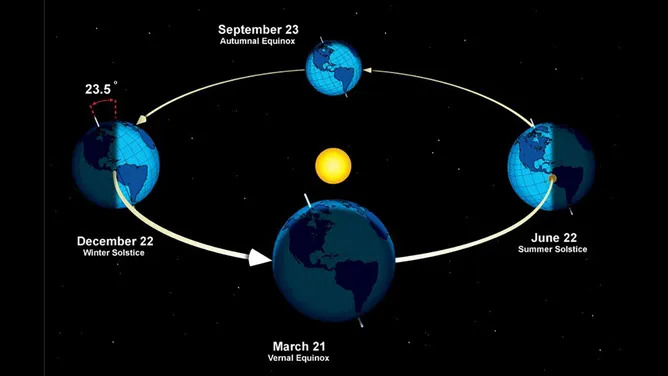
Earth’s tilt changes the length of daylight
The main reason sunrise and sunset times change from day to day is Earth’s axial tilt. Earth’s axis is tilted by approximately 23.4 degrees. As Earth travels around the Sun, this tilt causes each hemisphere to lean toward the Sun during one part of the year and away from it during another.
As a result, the length of time the Sun remains above the horizon changes throughout the year. On some days, daylight lasts longer, while on others, it is shorter. These changes in daylight length cause sunrise and sunset times to shift from one day to the next.
The effect also depends on the observer’s location. At high latitudes, especially near the polar regions, seasonal changes can become extreme. During certain parts of the year, the Sun may not rise at all, while at other times it may remain above the horizon throughout the entire day.
The seasons create the yearly pattern
In spring and early summer, many places experience progressively earlier sunrises and later sunsets, causing the days to grow longer. In autumn and winter, the opposite occurs: sunrise becomes later, sunset comes earlier, and the length of daylight decreases.
As explained above, this pattern is caused by Earth’s axial tilt and its orbit around the Sun. However, the seasons do not correspond to the same months everywhere. July and August are summer months in the Northern Hemisphere, while the Southern Hemisphere experiences winter during the same period. Because the seasons are opposite in the two hemispheres, their patterns of changing daylight are generally opposite as well.
Latitude makes the change bigger or smaller
Finally, let’s take a closer look at the effect of latitude. Earlier, we discussed how day length and sunrise and sunset times change with the seasons. However, the size of these changes depends greatly on latitude.
At higher latitudes, closer to the Arctic or Antarctic, summer days become much longer, while winter days become much shorter. Near the polar regions, the Sun may remain above the horizon for extended periods in summer, creating the midnight Sun. In winter, it may remain below the horizon for days or even months, resulting in polar night.
By contrast, regions near the equator receive a relatively consistent amount of daylight throughout the year. As a result, sunrise and sunset times remain much more stable, and the length of the day changes only slightly between seasons.