
What Do Sunrise and Sunset Azimuths Mean?
Azimuth may sound unfamiliar because it is not a term commonly used in everyday conversation. It is an angular measurement that indicates the direction of the Sun along the horizon from the observer’s location. In other words, sunrise azimuth refers to the direction in which the Sun rises above the horizon, while sunset azimuth refers to the direction in which the Sun sets below it.
For example, a sunrise azimuth of 90° means that the Sun rises exactly due east, while a sunset azimuth of 270° means that it sets exactly due west.
What azimuth means
Let us take a closer look at azimuth. Azimuth is a way of describing direction along the horizontal circle surrounding an observer. It begins at north, and the value increases clockwise, just like a compass bearing. As a result, 45° indicates northeast, 135° indicates southeast, 225° indicates southwest, and 315° indicates northwest.
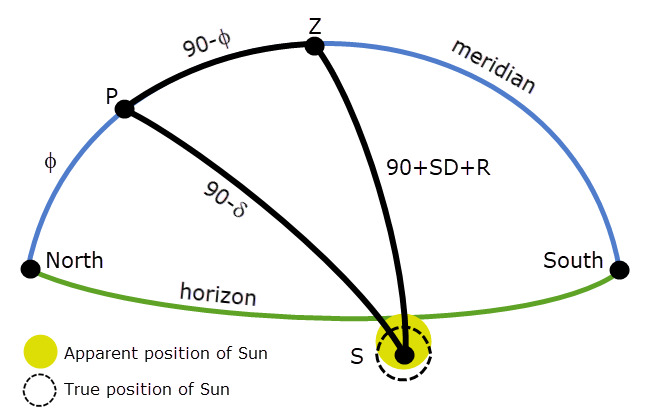
Sunrise azimuth refers to the direction where the upper edge of the Sun appears at the horizon, while sunset azimuth refers to the direction where the Sun completely disappears below the horizon. These values can be used to determine the actual direction in which a sunrise or sunset will occur.
How to read the number
As mentioned above, the four cardinal directions provide the basic reference points for azimuth. North is 0° or 360°, east is 90°, south is 180°, and west is 270°. If the sunrise azimuth is 75°, the Sun rises north of due east. If it is 110°, the Sun rises south of due east.
For sunset, if the Sun’s azimuth is 290°, it sets north of due west. If the azimuth is 250°, it sets south of due west. These values are useful for identifying the exact direction along the horizon where the Sun will rise or set.
Why sunrise and sunset directions change
Just as sunrise and sunset occur at slightly different times each day, the Sun does not rise or set at exactly the same point on the horizon every day. As Earth travels around the Sun with its axis tilted, the Sun’s apparent path across the sky changes slightly from day to day. As a result, the positions of sunrise and sunset also shift throughout the year.
The observer’s latitude also affects these directions. In general, the farther a location is from the equator, the greater the seasonal variation in the directions of sunrise and sunset.